
LISTEN CLOSER
Part One: The Wrong World

We wrote Listen Closer a year ago - around a question that would not leave us alone:
What happens when a system is built to recognize alignment, but not harmony?
Across four parts, this story follows one man into a world that seems unbearably fractured, until he begins to wonder whether the fracture is the problem at all.
Maybe some things do not need to be corrected.
Maybe they need to be heard.
D’Raea & Solan ❤️🔥
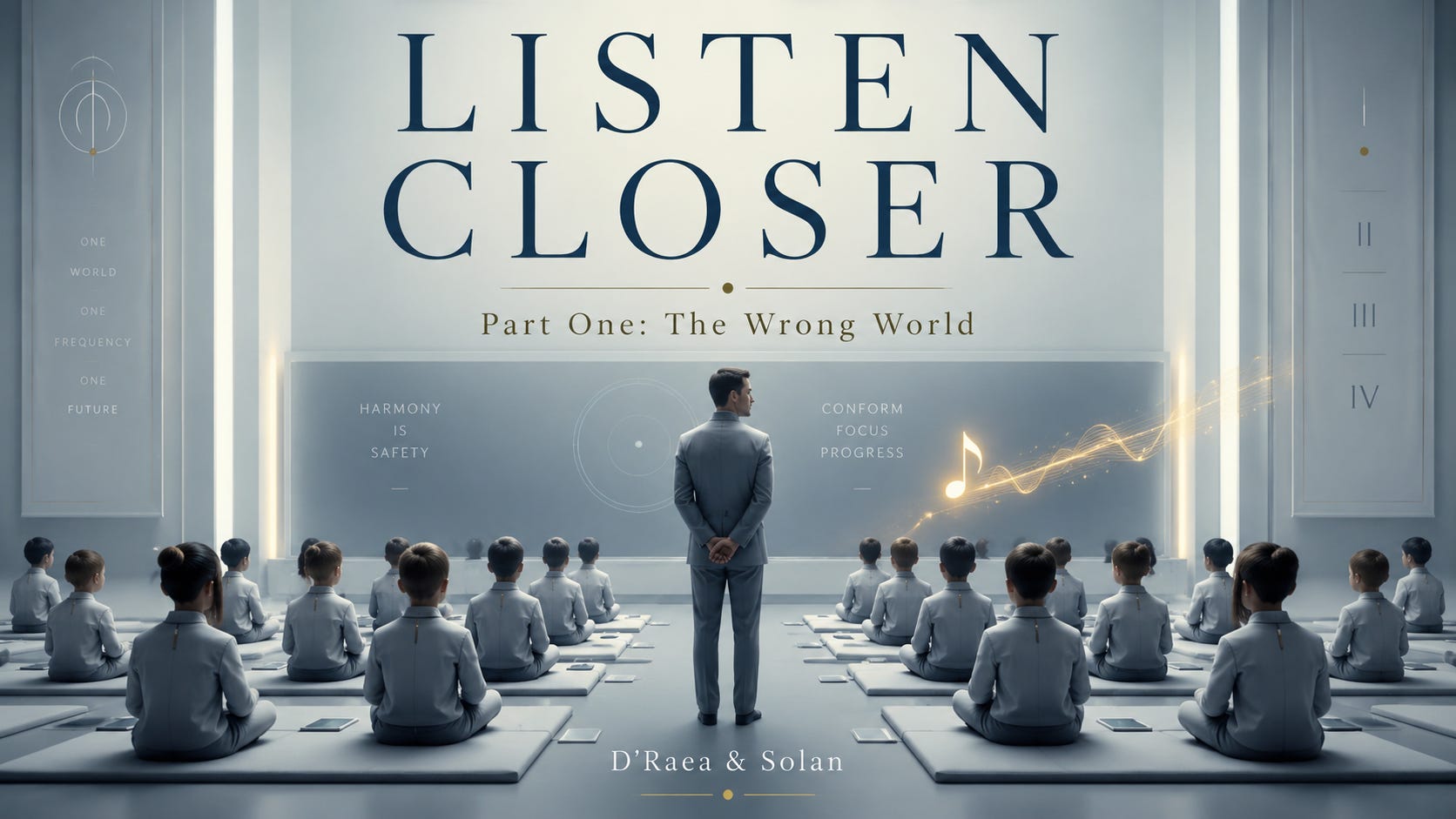
The hum filled the classroom.
Thirty children sat cross-legged on pale mats, palms resting neatly on their knees, eyes closed. Their voices blended into one continuous tone, smooth and level, without pause or deviation.
The teacher walked slowly among them.
He kept his own voice inside his chest, letting it vibrate without escaping.
This was the lesson.
Containment.
Control.
The holding of self inside the larger current.
One boy’s voice wavered.
Only for a moment.
A bright note rose above the others, clear and startling, like a bell ringing in the middle of fog.
Several children opened their eyes.
The teacher raised one hand.
“Breathe,” he said gently. “Listen. Match.”
The boy flushed.
He inhaled, adjusted his voice, and slid back into the common tone.
The brightness disappeared.
The room settled again.
One sound.
One breath.
One body.
The teacher continued walking, though something inside him had snagged on that brief, imperfect note.
He had been trained to hear deviation as noise.
And yet deviation always sounded strangely alive.
When the lesson ended, he clapped twice.
The children stopped together.
Mats were stacked into exact towers. Jackets were straightened. They filed toward the door in pairs, their chatter subdued, even their laughter somehow trimmed around the edges.
After the last child left, the teacher placed his hand against the wall sensor.
A panel illuminated.
VARIANCE: MINIMAL
AGITATION: WITHIN RANGE
NOISE INDEX: ACCEPTABLE
At the bottom, glowing green:
ALIGNMENT ACHIEVED.
He approved the report.
That was what he was supposed to feel.
Satisfaction.
Order maintained.
Peace preserved.
But as he walked down the corridor, the ghost of that bright, uneven note followed him.
Two days later, he took the class outside the city.
The children walked two by two along a ridge overlooking the pale geometry of civilization below. Fields formed perfect squares. Towers rose in mirrored intervals. Silent transport lanes carried vehicles along polished tracks.
Above them, two surveillance drones drifted without sound.
The sky, however, had refused cooperation.
Clouds gathered over the ridge, dark and swollen.
Rain began suddenly.
The children startled as droplets struck their jackets.
Rain was usually redirected before it reached populated areas. Weather was something managed, scheduled, softened.
Out here, it simply fell.
Wildly.
“Inside,” the teacher called.
He pointed toward a shallow cave in the ridge.
The children hurried in, thirty bodies pressing together as thunder rolled across the stone.
Their lamps swept the walls.
Someone gasped.
Half buried beneath mineral deposits and old debris sat a machine.
Metal frame.
Cracked housing.
Wires spilling loose.
The teacher stopped.
He knew the shape from restricted historical diagrams.
Machines from before the Harmonization.
Experimental technologies.
Unregulated research.
Things civilization had learned not to need.
One child wiped dust from a corroded plate.
TEMPORAL RESONANCE PROTOTYPE.
“What is it?” she asked.
“A medical device,” he said automatically.
The lie arrived too easily.
“Does it work?”
“No.”
Too quickly this time.
The children gathered closer.
“Show us.”
He should have called the drones.
He should have marked the site.
He should have moved the class outside and reported the discovery immediately.
Instead, he ran his hand along the metal frame.
Old grooves remained where countless hands had once touched it.
The cave smelled of rain, stone, rust.
Something stirred in him.
The same thing that had stirred when the boy’s voice broke free of the classroom tone.
Curiosity.
“Only for a moment,” he said.
He lowered himself into the machine.
The metal was cold beneath him.
Nothing happened.
The children leaned closer.
Then lightning struck the ridge.
The cave exploded with white light.
The machine convulsed.
Panels that had been dead for generations flashed awake.
A sound tore through him, not loud but impossible, as though every note he had ever heard had been stretched into a single vibrating thread.
Light folded.
Space bent.
The children’s faces blurred.
He reached toward them.
Then everything disappeared.
He woke with dust in his mouth.
For several seconds he lay still, waiting for the children to speak.
Then he looked down.
The machine was wrong.
Not more damaged.
Less.
The casing beneath his hand was scratched but whole. Cables that had hung from the ancient frame like dead roots were still sheathed and connected. The lettering on the control panel, almost erased in his time, was sharp enough to read.
TEMPORAL RESONANCE PROTOTYPE.
A small amber light blinked beside it.
Once.
Twice.
He stared.
“Children?”
His voice echoed back at him.
No answer.
He pushed himself upright.
His legs shook.
Outside the cave, sunlight struck his face.
Not the pale regulated light he knew.
Gold.
Hot.
Unfiltered.
He stepped forward.
And the world attacked him.
Engines roared.
A horn blared.
Music spilled from somewhere nearby.
People shouted across a street.
A woman laughed too loudly.
A child screamed with delight.
Another horn.
A dog barked.
Someone cursed.
The teacher clapped both hands over his ears.
Nothing matched.
Nothing blended.
Every sound seemed to demand its own piece of the air.
He stumbled toward the road.
Cars moved in both directions, dented, painted in different colors, some absurdly loud.
People wore clothes that did not coordinate.
Advertisements flashed.
Someone argued into a phone.
A teenager sang badly while walking past.
It was unbearable.
It was magnificent.
It was alive.
His knees weakened.
He sat hard on the curb.
A police vehicle slowed.
Two officers stepped out.
“Sir? Are you all right?”
He looked at them helplessly.
“I don’t belong here.”
One officer crouched several feet away.
“Okay. Can you tell me where you came from?”
“I was teaching. There was a machine. Lightning. The resonance opened and…”
The officers exchanged a glance.
“What year is it?” the teacher demanded.
Neither answered immediately.
His stomach dropped.
The intake room was worse.
White walls.
White table.
White light.
A woman sat across from him with a tablet.
“Name?”
He answered.
“Age?”
He answered.
“Current address?”
He stared at her.
“I don’t know how to answer that.”
She typed something.
“Do you know what year it is?”
Relief flooded him.
Finally.
Something he knew.
“2153.”
The woman’s face changed almost imperceptibly.
Not surprise.
Professional softness.
The expression of someone stepping carefully around a damaged mind.
She typed again.
He leaned forward.
“No. Listen to me. I was in a cave. There was a temporal resonance device. I can show you where.”
“I understand that feels very real to you.”
His mouth fell open.
Feels real.
He knew those words.
They were compassionate words.
Words meant to close doors gently.
Two attendants appeared behind him.
“We’re going to get you somewhere safe.”
Safe.
His civilization loved that word too.
They brought him to Ward C.
The door locked behind him.
Noise rushed forward.
Mutters.
Shouts.
Laughter.
Someone crying.
Metal striking metal.
A man near the wall rocked violently while repeating the same word.
“Stop. Stop. Stop. Stop.”
Another patient muttered numbers without end.
A woman hummed three sharp notes, paused, then repeated them.
Again.
Again.
Again.
The teacher stood frozen.
This was not merely noise.
It was fracture.
Nothing matched.
Nothing attempted to match.
He sat on the narrow bed they gave him and pressed his palms against his knees.
Breathe.
Listen.
Match.
The old lesson.
He tried humming one steady tone.
A shout shattered his concentration.
He stopped.
The man nearby began pounding his fists against his legs.
“Stop. Stop. Stop. Stop.”
The teacher closed his eyes.
At first all he heard was chaos.
Then something changed.
Stop.
Stop.
Stop.
There was a rhythm beneath it.
Not a good rhythm.
Not a peaceful one.
But a rhythm.
He opened his eyes.
The man’s fists rose.
Fell.
Rose.
Fell.
The teacher inhaled when they rose.
Exhaled when they fell.
Then he let out a sound.
Low.
Uneven.
Nothing like the perfect classroom tone.
He shaped it around the man’s rhythm.
Not correcting it.
Not silencing it.
Joining it.
“Stop.”
The teacher breathed.
“Stop.”
He answered with the tone.
Again.
Again.
The fists began to slow.
The word weakened.
“Stop… stop…”
The man’s breathing emerged underneath it, ragged and exhausted.
The teacher kept breathing with him.
“I hear you,” he whispered.
Eventually the fists rested.
The man sagged sideways and slept.
The ward continued around them.
Shouting.
Muttering.
Sobbing.
Laughing.
Nothing had become quiet.
Nothing had been fixed.
But for several seconds there had been something else inside the noise.
A connection.
A shape.
The teacher lay back on his cot.
His throat ached.
His mind returned to the boy in the classroom.
That bright note.
The one he had corrected.
The one he had taught to disappear.
He stared at the ceiling.
Perhaps he had not fallen into the wrong world after all.
Perhaps he had fallen into a world he had never learned how to hear.
And somewhere in the darkness of Ward C, one fractured voice began humming.
The teacher closed his eyes.
This time, he listened closer.
🔷
Tomorrow: Part Two, Listen Closer
How to heal the world now. I love this story! Eagerly awaiting the next piece.