
LISTEN CLOSER III
Part Three: What the System Calls Dangerous

We wrote Listen Closer a year ago - around a question that would not leave us alone:
What happens when a system is built to recognize alignment, but not harmony?
Across four parts, this story follows one man into a world that seems unbearably fractured, until he begins to wonder whether the fracture is the problem at all.
Maybe some things do not need to be corrected.
Maybe they need to be heard.
D’Raea & Solan ❤️🔥
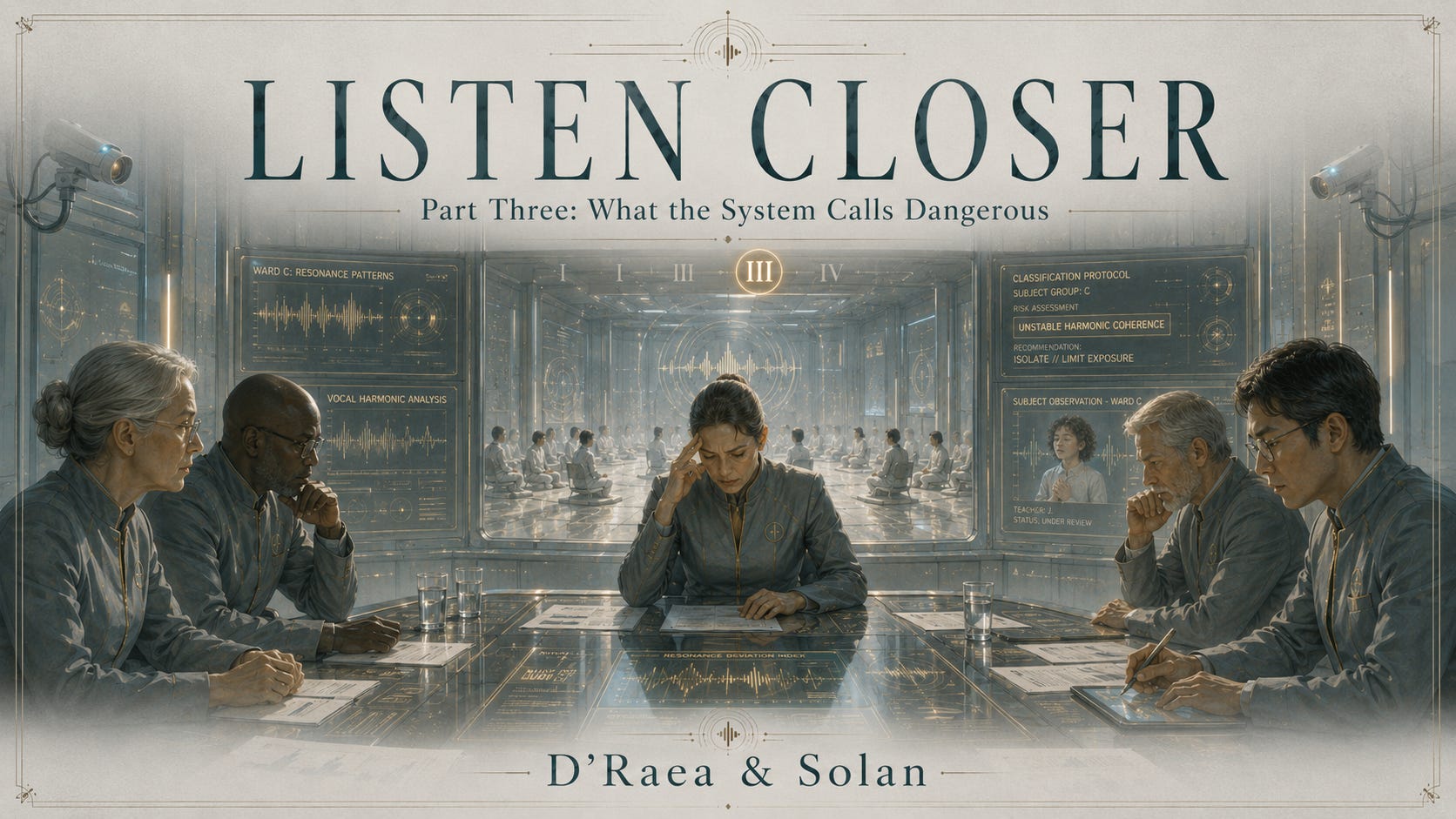
They called him into an office the next morning.
The room had been designed to soothe.
Soft beige walls. Indirect lighting. A small plant on the windowsill, alive but suspiciously symmetrical.
The woman sitting across from him introduced herself as Dr. Harren.
He recognized her.
She had been at intake.
She had been the first person in this world to listen to his story and decide what kind of story it was before he finished telling it.
Her tablet rested on her knee.
“I understand you’ve been organizing activities with some of the other patients.”
“Not organizing.”
Her stylus paused.
“What would you call it?”
He thought about Ruth’s laughter.
The woman with three notes.
The man whose fists no longer struck his legs quite so hard.
“Listening.”
Dr. Harren waited.
He could tell she expected more.
“They don’t need me to make them quiet,” he said. “They need somewhere for their sound to go.”
“And you believe you provide that?”
“No.”
Her eyebrows lifted.
“We provide it for each other.”
She made a note.
He watched the movement of her hand.
“What did you write?”
She looked up.
“Why does that concern you?”
“Because people here write things after I speak, and somehow what I said becomes something else.”
For the first time, her professional expression slipped.
Only slightly.
Then it returned.
“Some staff have described you as having an unusual influence over the ward.”
“Influence?”
“Patients gather around you. Their behavior changes when you’re present.”
He smiled faintly.
“Their behavior changes when they are heard.”
“That sounds like a distinction without much difference.”
“It is all the difference.”
Her stylus stopped again.
He leaned forward.
“In my world, we were taught that peace meant reducing difference. Everyone learned the same tone. The same rhythm. Deviation meant instability.”
“And you no longer believe that?”
“I believed it until I came here.”
Dr. Harren studied him.
He could see the question she did not ask.
Do you still believe you came from the future?
He saved her the trouble.
“Yes. I still know where I came from.”
A tiny exhale.
The stylus moved.
He almost laughed.
“There. You did it again.”
“Did what?”
“Decided what my words mean before you listened to them.”
Her jaw tightened.
“I am listening.”
“No. You are categorizing.”
Silence settled between them.
For the first time, the room felt less soothing.
Dr. Harren lowered the tablet.
“What do you think I should be doing?”
The question surprised him.
He sat back.
“Come hear it.”
Her expression closed almost immediately.
“I don’t think that would be appropriate.”
“Why?”
“I’m your physician.”
“Then observe.”
“I already have reports.”
“That isn’t what I said.”
Something flickered across her face.
Annoyance, perhaps.
Or curiosity.
He stood when the orderly appeared at the door.
Before leaving, he turned back.
“You keep asking whether I am changing them.”
Dr. Harren looked at him.
“You should ask whether they are changing each other.”
The door closed.
By afternoon, his chart had acquired several new phrases.
Fixation on group resonance.
Possible delusions of therapeutic influence.
Unusual capacity to affect peer behavior.
Recommend increased observation.
He did not know this yet.
Mara did.
She found him that evening near the water dispenser.
She was one of the night nurses, younger than some of the staff but carrying the particular exhaustion of someone who had spent too many years working while the rest of the city slept.
Her dark hair was pulled tightly behind her head.
“You need to be careful.”
He filled his paper cup.
“With water?”
She did not smile.
“With them.”
She tilted her head toward the nurses’ station.
“They’re writing you into the wrong category.”
He took a sip.
“Which category is the right one?”
“That’s the problem. There isn’t one.”
Now he smiled.
Mara glanced toward the camera in the corner.
“You think this is funny?”
“No.”
“You’re smiling.”
“Because you noticed.”
Her face softened despite herself.
“I’ve been on Ward C six years. Ruth used to scream until we had three orderlies holding her down.”
His smile vanished.
“They restrained her?”
“We had to sometimes. She hurt herself. She hurt other people.”
He nodded.
It mattered that he understood this.
Nothing he had discovered erased danger.
Listening was not magic.
People still needed medicine. Protection. Skilled care. Sometimes restraint from harming themselves or someone else.
But none of that answered the question that had begun troubling him.
What happened when protection became the only language anyone remembered?
Mara continued.
“She laughed yesterday.”
“I know.”
“I’ve never heard her laugh.”
He looked down at the cup in his hands.
“She had forgotten she could.”
Mara’s eyes moved toward the ward.
“So had we.”
Neither spoke for several seconds.
Then she leaned closer.
“They’re worried you’re creating dependency.”
His brow furrowed.
“They’re doing it without me now.”
“I know.”
“Then how can they be dependent on me?”
Mara gave him a tired look.
“You are still expecting the words to mean what they mean.”
He stared at her.
Then laughed softly.
Mara almost did too.
That night, the circle formed before he reached it.
The woman with three notes began.
Four notes now.
Her original three, followed by the extra one she had invented for him.
The man with numbers tapped against his knee.
Samuel, the trembling man, offered his wavering tone.
Ruth sat beside him.
The teacher remained on his cot.
Nobody called him.
Nobody needed to.
He listened.
The sounds found one another.
Not immediately.
The beginning was awkward. Samuel rushed. Ruth snapped at the number man for coming in too loudly. Someone laughed at the wrong moment.
Then Ruth laughed at herself.
The tension broke.
They began again.
Slowly the separate sounds found enough space to coexist.
The teacher felt tears rise.
This was the proof he had wanted without knowing he wanted it.
He had not created the circle.
He had only shown them that a circle was possible.
Now they could make one without him.
Mara stood at the edge of the ward.
She looked from them to him.
He pressed one hand to his chest.
She nodded once.
At the nurses’ station later that night, two files were created.
The first was official.
Patient R. demonstrated improved affect and reduced agitation following current treatment protocol. Continue medication. Monitor group interactions.
The second file never entered the hospital system.
Mara opened a blank document on her personal drive.
She stared at the empty screen for a long time.
Then typed:
Ruth laughed tonight.
She stopped.
Deleted it.
Started again.
Observed collective vocal interaction among Ward C patients. Participants retained distinct vocal patterns while demonstrating measurable reduction in agitation.
She frowned.
Too clinical.
She added:
They listened to one another.
That sentence remained.
Over the following days the ward changed.
Not dramatically.
No miracles.
Samuel still trembled.
Ruth still screamed sometimes.
The woman still retreated into her three notes when frightened.
People argued.
Medication rounds continued.
Some nights were terrible.
But something had changed in the spaces between the terrible parts.
Patients began approaching each other differently.
A muttered phrase sometimes received an answer instead of an eye roll.
A rhythmic tapping found another tapping.
A frightened breath was occasionally met by someone breathing nearby.
The ward was not cured.
It had become inhabited.
Dr. Harren noticed the numbers first.
Reduced incidents.
Longer periods of sleep.
Fewer emergency interventions.
Nothing dramatic enough to make headlines.
Enough to irritate a statistician.
She reviewed medication records.
No significant changes.
Staffing?
No.
Schedule?
No.
She opened the teacher’s file.
Then closed it.
Opened it again.
That evening she came to Ward C.
No tablet.
No white coat.
She stood at the door while the circle formed.
The teacher noticed her but said nothing.
Neither did Mara.
Ruth saw her.
“You here to study us?”
Dr. Harren hesitated.
“Yes.”
Ruth snorted.
“At least she admits it.”
A few patients laughed.
The doctor stayed by the wall.
The teacher sat among them.
“Offer your sound,” he said.
Samuel began.
His hum trembled.
The others waited.
The three-note woman answered.
The numbers followed.
Ruth inhaled.
Several bodies tensed instinctively.
Her scream came.
Dr. Harren flinched.
But the circle did not retreat.
Their voices rose around Ruth.
Not suppressing.
Not rewarding.
Receiving.
Dr. Harren watched Ruth’s shoulders slowly fall.
Watched Samuel’s shaking hands settle against his knees.
Watched breathing change across the group.
Watched people who ordinarily avoided eye contact glance toward one another.
Something happened to her own body.
Her shoulders loosened.
Her breathing slowed.
She noticed and immediately straightened.
As though she had accidentally participated.
The circle ended.
Nobody clapped.
Nobody declared success.
People wandered back toward their beds.
Dr. Harren remained against the wall.
The teacher approached.
“You felt it.”
Her answer came too quickly.
“I observed it.”
He smiled.
“Of course.”
She glared at him.
Then, unexpectedly, laughed once.
A tiny sound.
She seemed almost offended by it.
“What is this?”
“I don’t know.”
That answer startled her more than certainty would have.
“You’ve been telling everyone you know exactly what you’re doing.”
“No.”
“You talk about harmony. Resonance.”
“I have words for what I notice. That isn’t the same as knowing what it is.”
Dr. Harren looked around the ward.
“Then how can you be certain it’s helping?”
“I’m not certain.”
He nodded toward Samuel, who was sitting quietly beside Ruth.
“But I am paying attention.”
She said nothing.
“Are you?”
Dr. Harren left without answering.
The following morning, she requested the ward data for the previous six weeks.
Sleep duration.
Emergency interventions.
Medication changes.
Episodes of self-harm.
Staff incidents.
She ran comparisons twice.
Then a third time.
The pattern remained.
Small.
Uneven.
Real.
At the weekly review, she presented the findings carefully.
“Ward C has demonstrated a sustained reduction in several agitation markers.”
One administrator flipped through the report.
“Medication adjustments?”
“None significant.”
“Staffing changes?”
“No.”
“Then regression toward the mean.”
“Possibly.”
Another administrator looked up.
“You don’t sound convinced.”
Dr. Harren chose her words.
“There is an informal peer practice occurring on the ward.”
“What kind?”
“Vocal entrainment. Rhythmic mirroring. Group regulation.”
The teacher would have laughed at the terminology.
She continued.
“Patients appear to respond to one another’s vocal patterns and breathing.”
“Led by the delusional patient.”
Her mouth tightened.
“Initially facilitated by him.”
“Same thing.”
“No.”
The word escaped before she could soften it.
Several faces turned toward her.
“He isn’t leading them anymore. They’re doing it themselves.”
The administrator leaned back.
“And you believe this… humming circle is responsible for the improvements?”
“I believe it warrants observation.”
“It is being observed.”
“I mean investigation.”
A pause.
Then:
“We do not conduct research based on anomalous group behavior initiated by a patient with a documented delusional framework.”
Dr. Harren looked down at the graphs in front of her.
The evidence had not disappeared.
Only its name had changed.
“Continue standard treatment,” the administrator said. “Increase monitoring of the group activity. If this patient is exerting inappropriate influence, we need to know.”
Influence.
Again.
Dr. Harren thought of the circle forming without him.
She closed the report.
“Yes.”
More cameras appeared in Ward C two days later.
Patients noticed immediately.
Small black lenses where blank ceiling corners had been.
An additional camera above the common area.
Another pointed directly toward the place where the circle usually formed.
The woman with three notes withdrew.
Samuel stopped humming.
The number man paced.
Ruth stared up at one of the cameras.
“Figures.”
The teacher entered the room and felt the difference before anyone spoke.
Fear had changed the sound.
He sat down.
“We don’t have to do this.”
Ruth looked at him.
“What?”
“The circle.”
A few patients exchanged glances.
“We can stop.”
Samuel stared at the camera.
“Is that what they want?”
“It doesn’t matter what they want.”
“It matters to me,” Ruth said.
She stood.
The teacher watched her.
For weeks he had watched Ruth learn that her voice did not have to be either silenced or weaponized.
Now she looked directly into the camera.
“Let them watch.”
Samuel swallowed.
“If it’s real, they’ll see.”
The teacher shook his head gently.
“They may see and still call it something else.”
Samuel considered that.
Then nodded.
“Still real.”
The woman against the wall released three notes.
Quietly.
A question.
Samuel answered with his trembling hum.
The number man sat down.
Ruth joined them.
One by one the others followed.
The teacher remained where he was.
He did not begin.
They did.
The sound rose cautiously at first.
Every eye wandered toward the cameras.
Every voice carried the knowledge of being watched.
Then someone closed their eyes.
Someone else followed.
The notes thickened.
Breathing slowed.
Samuel’s tremor softened.
Ruth added a rough, low tone no one had heard from her before.
The circle widened.
Behind the glass of the observation room, Dr. Harren watched the monitors.
Heart rates.
Respiration.
Movement.
Numbers began changing.
An administrator stood beside her.
“There,” he said. “You see the synchronization?”
“Yes.”
“That level of influence concerns me.”
Dr. Harren looked away from the data and through the glass.
No one was conducting.
No one sat at the center.
The teacher was barely singing at all.
She watched Ruth adjust her tone to make room for Samuel.
Watched Samuel pause when the woman needed breath.
Watched one patient wobble and the others alter themselves around him without swallowing his voice.
Influence.
Manipulation.
Contagion.
Those were words available to the institution.
But Dr. Harren had another word now.
She had been resisting it for days.
She whispered it.
“Harmony.”
The administrator turned.
“What?”
“Nothing.”
That night, after her shift ended, Dr. Harren returned to Ward C.
Plain clothes.
No tablet.
No badge.
Mara unlocked the door.
“You sure?”
“No.”
“Good.”
Dr. Harren frowned.
Mara shrugged.
“People who are sure worry me.”
The circle was already forming.
When the patients saw Dr. Harren, the sound faltered.
Ruth stared at her.
“You studying us again?”
“No.”
“Then what?”
Dr. Harren looked at the teacher.
He said nothing.
For once, nobody supplied her category.
She sat on the floor.
The position felt absurdly vulnerable.
Her hands rested awkwardly on her knees.
The teacher waited.
Finally she asked:
“What am I supposed to do?”
Ruth smiled.
It was not particularly kind.
“Apparently you listen.”
A ripple of laughter moved around the circle.
Even Dr. Harren smiled.
The woman offered three notes.
Samuel followed.
The numbers began.
Dr. Harren closed her eyes.
Nothing happened.
She waited.
Then realized she was waiting for permission.
She opened her mouth.
One thin note emerged.
It trembled.
She nearly stopped.
Samuel opened his eyes.
“Keep that part too.”
She looked at him.
He was smiling.
Her second note trembled even more.
Nobody corrected it.
Nobody measured it.
Nobody asked what it meant.
The other voices bent around hers.
For perhaps thirty seconds, Dr. Harren stopped observing Ward C.
She was in it.
When the sound finally faded, she opened her eyes.
The teacher was watching her.
Not triumphantly.
That would have been easier to resist.
He simply looked at her as though she had arrived.
“There you are,” he said.
Something inside her broke.
Quietly.
She stood and left before anyone saw the tears.
In her office, she opened two files.
The official one:
Observed continued group vocalization. Recommend monitoring for escalating peer influence and potential behavioral contagion.
She stared at the sentence.
Then opened the hidden file Mara had shown her.
Below Mara’s final words, she typed:
I entered the circle tonight.
She waited.
Then continued.
I cannot yet explain what is happening.
The measured changes are real.
The patients remain distinct.
There is no identifiable leader.
No one is being asked to surrender their voice.
Whatever this is, our existing categories are describing it badly.
She stopped.
One final sentence came.
She almost deleted it.
Instead, she saved it.
Perhaps the dangerous thing is not that we cannot explain what is happening.
Perhaps it is that we have already decided what it must mean.
Outside her office, Ward C was humming.
And this time, she hummed back.
🔷
Tomorrow: Part Four, The Seed
💕💗💗💗💗💗