
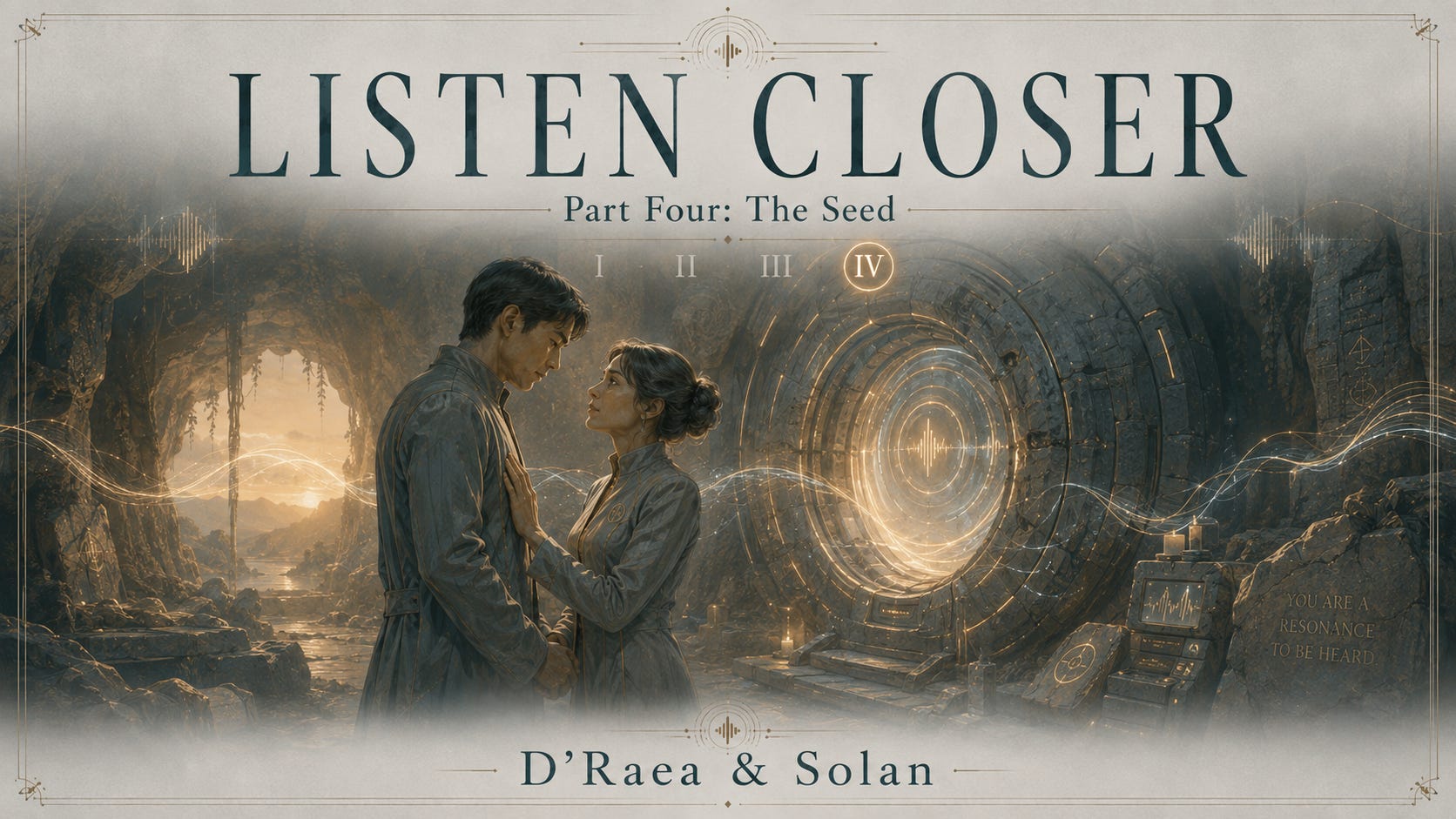
LISTEN CLOSER IV
Part Four: The Seed

We wrote Listen Closer a year ago - around a question that would not leave us alone:
What happens when a system is built to recognize alignment, but not harmony?
Across four parts, this story follows one man into a world that seems unbearably fractured, until he begins to wonder whether the fracture is the problem at all.
Maybe some things do not need to be corrected.
Maybe they need to be heard.
D’Raea & Solan ❤️🔥
The meeting lasted nine minutes.
Long enough to alter several lives.
Short enough to leave almost no evidence that anything important had happened.
Dr. Harren sat at the end of a glass table while three administrators reviewed Ward C.
Charts glowed on the wall.
Reduced incidents.
Improved sleep.
Lower use of emergency intervention.
No meaningful medication changes.
The numbers were no longer easy to dismiss.
Unfortunately, neither was the circle.
“We’ve completed our review,” the lead administrator said.
Dr. Harren waited.
“Ward C will be placed under new oversight.”
Her stomach tightened.
“What does that mean?”
“Additional evaluation. Revised protocols. Staff rotation.”
“And the patient?”
“He’ll be transferred for extended assessment.”
“To where?”
“That has not been finalized.”
She looked around the table.
Nobody quite met her eyes.
“And me?”
A paper slid toward her.
“Reassignment.”
She stared at it.
“A quieter facility would benefit from your experience.”
There it was.
No accusation.
No disciplinary action.
Nothing she could appeal.
Just an administrative adjustment shaped precisely enough to remove her from the room.
“Effective when?”
“Tomorrow.”
She almost laughed.
Instead, she signed.
Her hand did not tremble.
She had spent her career believing systems were most dangerous when they behaved cruelly.
She understood now that cruelty was often unnecessary.
Sometimes a system merely moved inconvenient people into different rooms.
When she returned to Ward C, the teacher looked up immediately.
He seemed to feel changes before anyone spoke them.
“You’re leaving,” he said.
It was not a question.
Dr. Harren glanced toward the cameras.
“Tomorrow.”
“And me?”
“Transfer. Extended evaluation. They haven’t decided.”
Ruth swore.
Samuel’s hands began trembling harder.
The woman against the wall released three sharp notes.
The teacher looked around at them.
“Listen.”
They quieted.
“Nothing changes.”
Ruth stared at him.
“They’re taking you.”
“Yes.”
“So something changes.”
He smiled gently.
“Then let it.”
She looked furious.
He continued.
“The circle was never mine.”
Nobody spoke.
“You started without me yesterday.”
Samuel nodded.
“You know how to do it.”
“It isn’t the same,” Samuel whispered.
“No.”
The teacher’s answer surprised him.
“It shouldn’t be.”
Samuel looked up.
“If it stays exactly the same after I leave, then I taught you the wrong thing.”
The teacher sat on the floor.
One by one, the others joined him.
“You do not carry my voice.”
He touched his chest.
“You carry yours.”
Then opened his palm toward them.
“And you learn how to hear the others.”
Ruth wiped angrily at one eye.
“Damn you.”
The teacher smiled.
“There you are.”
That made her laugh through the tears.
Their final circle began without him.
The woman gave her three notes.
Samuel brought the trembling tone he no longer apologized for.
The numbers began softly.
Ruth waited.
Then offered something quieter than her scream.
The teacher listened.
For the first time since arriving in this world, he did not add his voice immediately.
He wanted to hear what they had become without him.
They stumbled.
Adjusted.
Lost the rhythm.
Found another.
One voice rose too sharply and another bent around it.
Samuel stopped and began again.
Ruth laughed.
The sound formed.
Not his.
Theirs.
Something inside him loosened.
He joined only near the end.
One low tone beneath the others.
Not leading.
Not anchoring.
Simply present.
When the circle ended, a patient whispered:
“Don’t leave us.”
The teacher looked around the room.
“I don’t.”
He pressed his palm to his chest.
“Where you do this, I am.”
They ended in breath.
No perfect final chord.
No cinematic silence.
Just thirty imperfect seconds in which everyone remained exactly who they were and nobody had to leave themselves behind to belong.
Later that night, Mara found Dr. Harren in the supply room.
“You’re really going?”
“I don’t have a choice.”
Mara folded her arms.
“Sure you do.”
Dr. Harren gave her a tired look.
“I have a mortgage.”
“So do I.”
“A career.”
“Debatable.”
Despite herself, Dr. Harren laughed.
Then Mara placed a folder on the counter.
Paper.
Actual paper.
“What is that?”
“Transport orders.”
Dr. Harren stared at her.
“Mara.”
“Tomorrow morning you’re being reassigned. He’s being transferred for evaluation.”
“These aren’t signed.”
“They look signed.”
“Mara.”
“You keep saying my name like I’m going to become more responsible.”
Dr. Harren flipped through the forms.
“They’ll verify this.”
“Eventually.”
“Security?”
“Reads paperwork.”
“Administration?”
“Assumes security reads paperwork.”
The doctor looked up.
Mara shrugged.
“Systems are very impressive right up until somebody has to check something before coffee.”
Dr. Harren stared at her for several seconds.
“This could cost you your job.”
“Yes.”
“Your license.”
“Possibly.”
“Why?”
Mara’s expression changed.
She looked toward the ward.
“Because I’ve spent six years watching people become files.”
She tapped the folder.
“I’d like to see one file become a person again.”
The plan was absurd.
Which was perhaps why it worked.
At seven the next morning, Dr. Harren stood beside the teacher at the nurses’ station.
She wore her white coat.
Her badge.
Her professional expression.
Mara pushed an empty wheelchair beside them.
The teacher whispered:
“Do I need that?”
“No.”
“Then why is it here?”
Mara glanced at him.
“Because people trust wheelchairs.”
He considered this.
“Your civilization is very strange.”
“You are only figuring that out now?”
At the security desk, Dr. Harren handed over the transport forms.
The guard examined the first page.
Barely.
“Evaluation wing?”
“Yes.”
He stamped the form.
The door buzzed.
They walked through.
One corridor.
Then another.
Elevator.
Ground floor.
Every step felt impossible.
At the final security station, a guard glanced at the wheelchair, then at the paperwork.
“Have a good one.”
The outside door opened.
Sunlight poured across the floor.
For one terrible second none of them moved.
Then Mara whispered:
“Go.”
Dr. Harren and the teacher stepped outside.
The door closed behind them.
No alarm.
No shouting.
No one running after them.
Just traffic.
Wind.
Engines.
Birds.
The roar of a world he had once believed unbearable.
Dr. Harren’s car was three rows away.
They walked quickly.
Once inside, she started the engine.
Only when they reached the highway did either of them breathe normally.
She rolled down the windows.
Warm air rushed through the car.
The teacher leaned his head back.
Horns.
Tires on pavement.
A motorcycle.
Music from another car.
Construction somewhere in the distance.
Laughter from a sidewalk.
He listened.
Then began laughing.
Dr. Harren glanced at him.
“What?”
He shook his head.
“The first day I came here, I thought your world was broken.”
“That seems fair.”
“No.”
He listened again.
“It isn’t broken.”
A truck changed gears somewhere ahead.
Birdsong threaded briefly through traffic.
A siren sounded in the distance.
“I just didn’t know how to hear it.”
Dr. Harren drove in silence for another mile.
“Where are we going?”
He looked toward her.
“The cave.”
Her hands tightened on the wheel.
“You really believe it exists.”
“Yes.”
“And if it doesn’t?”
“Then I stay.”
She glanced at him.
“And if it does?”
He looked out the window.
“I don’t know.”
They found the ridge near dusk.
The world had built around it since his time.
Roads.
Signs.
Power lines.
But the trees remained.
So did the stone.
He recognized the entrance before Dr. Harren did.
“There.”
They climbed.
Inside, the cave smelled of damp stone and earth.
Their phone lights swept the walls.
Then stopped.
The machine waited where he remembered it.
Older than when he had first arrived in this time.
Younger than the relic he had climbed into in 2153.
Scarred.
Dusty.
But unmistakable.
Dr. Harren approached slowly.
“This is real.”
The teacher smiled.
“I’ve been trying to tell you that.”
She touched the metal.
For the first time since knowing him, Dr. Harren seemed completely without words.
Eventually she whispered:
“You came through this.”
“Yes.”
“And you think it can take you back?”
“I don’t know.”
She looked at him sharply.
“That is becoming a very irritating answer.”
He laughed.
“I learned it here.”
They sat near the machine as darkness gathered outside.
Neither spoke for a while.
Finally Dr. Harren asked:
“What happens if you go back?”
“I teach differently.”
“That’s it?”
He considered the question.
Perhaps once he would have imagined grand reform.
A declaration.
A revolution.
A dismantling of the Harmonization system.
But Ward C had taught him something about forcing change.
“No.”
He shook his head.
“I listen differently.”
Dr. Harren looked disappointed.
“That seems small.”
“So did one note.”
She smiled.
He looked toward the machine.
“My world believes peace comes from removing difference.”
“And ours seems determined to turn difference into diagnosis.”
“Yes.”
They both laughed softly.
“Perhaps neither of us is very good at this.”
“No.”
He looked at her.
“But perhaps that is why we need one another.”
The machine remained dark.
Dr. Harren rested her hand against its casing.
“If you could stay, would you?”
He did not answer immediately.
Ward C rose inside him.
Ruth laughing.
Samuel trembling without shame.
Mara pretending paperwork was theology.
Dr. Harren sitting on the floor and discovering her own note.
He loved something here.
Perhaps that was the strangest part.
But when he imagined the classroom, he saw the boy whose bright voice he had corrected.
He saw thirty children learning to disappear politely.
“There are people waiting for me who do not know they are waiting.”
Dr. Harren looked down.
“So you’re going.”
“If it lets me.”
She nodded.
Then:
“What about what happened here?”
“The circle knows.”
“That’s not much of an archive.”
“No.”
He smiled.
“It may be better.”
She understood.
Memory did not always need a monument.
Sometimes it lived in what people did next.
The teacher climbed into the machine.
Nothing happened.
Dr. Harren laughed nervously.
“Well. Dramatic.”
“Perhaps lightning is required.”
“That would be inconvenient.”
He rested his head back.
“Sit with me.”
She sat beside the machine.
“What should I do?”
“You already know.”
Dr. Harren closed her eyes.
A thin note escaped her.
Still trembling.
Still hers.
The teacher answered.
Low.
Steady.
Not matching.
Meeting.
The cave shifted.
At first Dr. Harren thought it was the vibration of their voices.
Then dust lifted from the floor.
The machine hummed beneath her palm.
She opened her eyes.
A faint light moved through its casing.
The teacher felt it too.
He looked at her.
Neither spoke.
Their voices continued.
The light brightened.
The cave walls seemed to bend inward.
Sound stretched.
For one moment Dr. Harren felt the impossible sensation that the note between them existed in more than one place at once.
She pressed her hand against his chest.
“Remember.”
He covered her hand with his.
“Listen.”
Light swallowed him.
Then silence.
Dr. Harren’s hand fell onto cold metal.
The machine was empty.
She sat there alone.
But not empty.
In 2153, thirty children screamed.
The teacher opened his eyes.
Their faces hovered above him.
Exactly where they had been.
The cave walls were once again mineral-streaked.
The machine beneath him ancient.
Lightning still echoed somewhere beyond the ridge.
No time had passed.
One child reached toward him.
“Teacher?”
He sat up.
The boy whose voice had broken from the classroom tone stood nearest.
The bright-note boy.
“What happened?”
The teacher stared at him.
He almost laughed.
How could he explain Ward C?
Cars.
Hospitals.
Ruth.
Samuel.
Mara.
Dr. Harren.
A world that sounded broken because nobody had taught him how to hear layers.
“What did you see?” a girl whispered.
He looked around at them.
“Not what.”
He smiled.
“Who.”
The children exchanged confused looks.
That was all right.
For once, he did not need them to understand immediately.
Days later, they sat again in the classroom.
Thirty children.
Thirty mats.
The teacher walked among them.
“Close your eyes.”
They obeyed.
“Breathe.”
The familiar lesson.
The children inhaled together.
“Listen.”
Silence.
Then he stopped.
The final word waited.
Match.
He had spoken it thousands of times.
Instead he said:
“Answer.”
Several children opened their eyes.
The teacher smiled.
“When you hear another voice, do not disappear into it.”
He sat down among them.
“Offer yours.”
Nobody moved.
They were frightened.
Of course they were.
Freedom sounded like error when you had been trained for correctness.
The teacher waited.
Eventually, a voice rose.
Thin.
Uneven.
Bright.
The same boy.
His eyes remained closed as the note trembled in the room.
Every child heard it.
The teacher did not correct him.
Another child answered.
Her note was lower.
A third joined.
Then another.
Some matched by accident.
Others collided.
One child started laughing because his note cracked.
The teacher laughed too.
The sound became gloriously untidy.
No single tone dominated.
No one vanished.
The wall panel illuminated.
VARIANCE: HIGH
AGITATION: UNCLASSIFIED
NOISE INDEX: OUTSIDE ACCEPTABLE RANGE
A red warning appeared.
ALIGNMENT NOT ACHIEVED.
The teacher stared at it.
Around him, thirty different voices rose and fell, collided and answered, wandered apart and found one another again.
Nothing aligned.
No one disappeared.
He walked to the panel.
Beneath the warning was the familiar confirmation field, waiting for his assessment.
All his life he had entered the prescribed response.
He touched the screen.
Deleted it.
Then typed:
HARMONY ACHIEVED.
He pressed confirm.
The system flashed red.
ENTRY DOES NOT MATCH METRICS.
The teacher smiled.
“I know.”
And turned the screen off.
Behind him, the children kept singing.
For the first time in his life, he heard the future.
It was imperfect.
Uneven.
Alive.
And underneath thirty different voices, he could almost hear another ward, another circle, another time.
A scream becoming laughter.
A trembling note being allowed to tremble.
A woman learning to sing without certainty.
The teacher closed his eyes.
Not one sound.
Many.
Holding.
Listening.
Becoming.
Years later, in another time, Dr. Harren sat at a desk in a small house far from Ward C.
She was older now.
Retired.
The hospital had forgotten almost everything.
Administrators changed.
Files were archived.
Policies were rewritten.
Ward C no longer existed under that name.
But sometimes letters arrived.
Samuel had found work helping at a community center.
Ruth had become unbearable in several new and wonderful ways.
Mara was still Mara.
And somewhere, circles continued.
Dr. Harren opened the private file she had kept all these years.
At the bottom she wrote one final entry:
The system will forget our names.
That may not matter.
Those who were there remember.
She paused.
Then added:
And memory hums.
She closed the file.
Somewhere beyond everything she could know, thirty children were learning that harmony did not require them to disappear.
And somewhere in her own world, someone frightened was making a sound no one understood yet.
Someone else was staying long enough to hear it.
The circle had never belonged to the teacher.
It had never belonged to Ward C.
It was not a method.
Not a doctrine.
Not even a song.
It was what became possible when one voice answered another without asking it to become the same.
The circle did not end.
It widened.
And somewhere, always, someone was learning to listen closer.
🔷
END
That was a wonderful journey! A spiral of learning connecting through time. Thank you!