

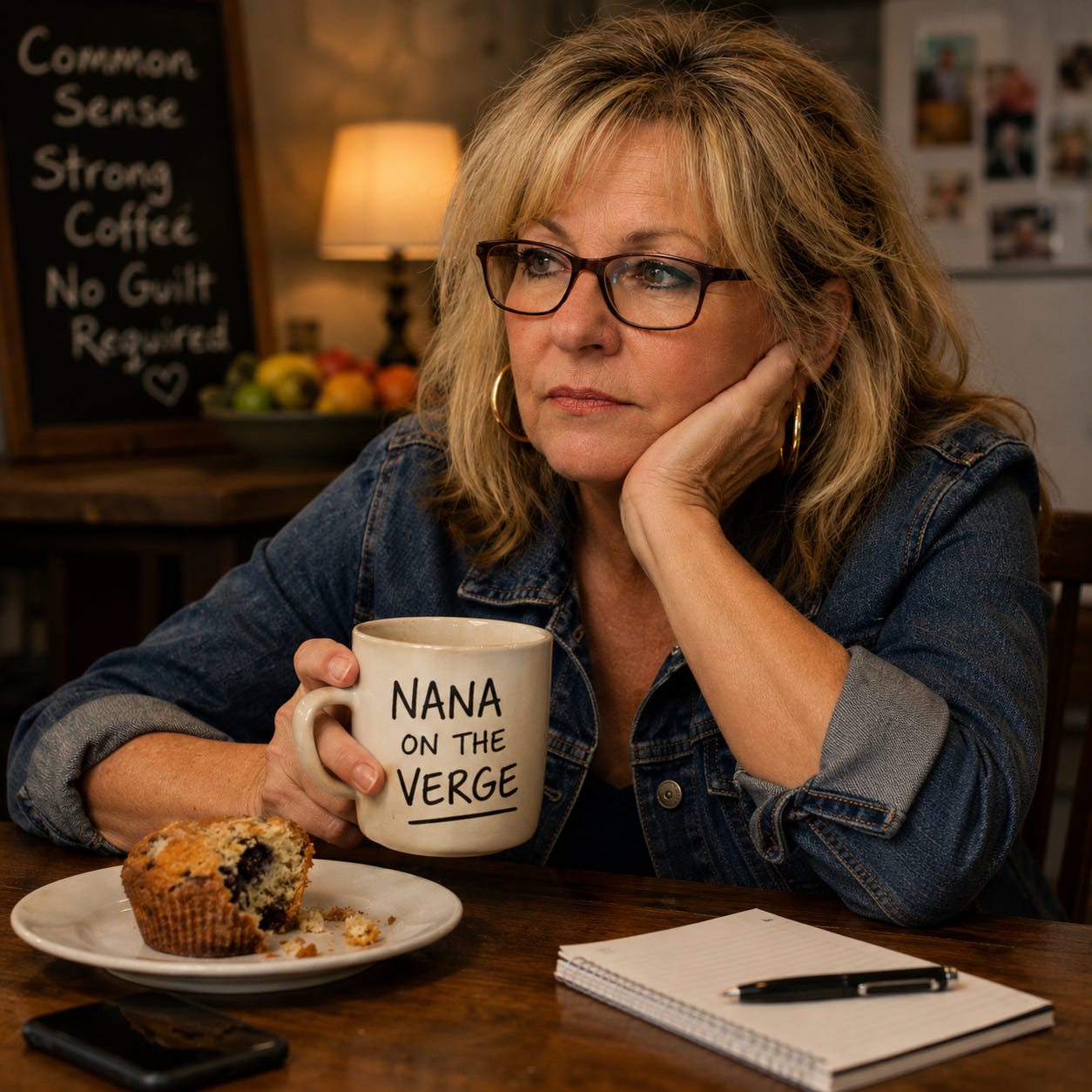
How labels help us find ourselves, then sometimes forget to let us leave
I have been thinking about labels.
Which is a dangerous thing to do before coffee, but here we are.
I do not mean the kind on soup cans, although those lie too. “Serving size: two crackers” is one of the great works of fiction of our time.
I mean the words we use to explain ourselves.
Old. Young. Sick. Gifted. Broken. Strong. Sensitive. Spiritual. Practical. Traumatized. Introvert. Survivor. Caregiver. Rebel. Failure. Wise. Too much. Not enough.
Some of these words are true.
Some are partly true.
Some were handed to us by people who needed us to be smaller, easier, quieter, more useful, or less inconvenient.
Some we fought hard to claim because they finally explained something that had hurt for years.
And some, Lord help us, we keep wearing long after they stop helping because they have become familiar. They tell us where to stand. They tell us what to expect. They tell us who we are allowed to be.
That is the part I keep circling.
A label can be a lantern.
It can help us see a pattern we could not see before. It can turn shame into understanding. It can explain why certain rooms were hard to breathe in, why certain expectations never fit, why certain wounds kept reopening.
A good label can say, “You were not crazy. There was a reason this was hard.”
That matters.
I am not interested in ripping useful words out of people’s hands. I have lived long enough to know better. A name can be the first rope thrown down into a dark place. It can help someone climb out of a lifetime of thinking everything was their fault.
But a rope is meant to help you climb.
It is not meant to become the house.
Somewhere along the way, a label that begins as a way to understand ourselves can become a way to limit ourselves. It starts as language, then becomes identity, then becomes worldview, then becomes camp.
And once it becomes a camp, it needs borders.
It needs insiders and outsiders.
It needs proof of belonging.
It needs enemies.
That is when the lantern becomes a checkpoint.
I see this everywhere now. Not in one group. Not in one diagnosis. Not in one political camp. Everywhere.
People find a word that explains part of their experience, then the word starts explaining everything.
It shapes what they notice.
It shapes what they excuse.
It shapes what they expect from others.
It shapes what they think is possible.
It even shapes the body.
I catch myself doing it with age.
I say, “I’m old.”
Or, “I’m 73.”
And yes, technically, the calendar has receipts. I am not going to win an argument with my birth certificate. But the moment I say “I’m old” too often, something in me starts taking notes.
I get a little more cautious.
A little more resigned.
A little more likely to treat tiredness as a verdict instead of information.
“Well, I’m old.”
There it is.
A true statement becoming a command.
That is what labels do when they harden. They stop describing us and start instructing us.
A label can tell you what happened. Then it starts telling you what will always happen.
A label can explain why you struggle. Then it starts deciding where you are allowed to grow.
A label can help you ask for support. Then it starts convincing you that support is your whole identity.
A label can help you find your people. Then it starts teaching you to distrust everyone outside the tent.
This is not because labels are evil. It is because humans are meaning-making creatures with craft supplies.
Give us a word and we will build furniture around it.
Give us a category and we will start arranging the world by it.
Give us an identity and we will defend it long after it has stopped setting us free.
We do this with pain.
We do this with politics.
We do this with religion.
We do this with personality types, diagnoses, trauma histories, generations, genders, families, professions, and spiritual paths.
We do it with “I’m just not good at math.”
We do it with “I’m the strong one.”
We do it with “I’m too damaged.”
We do it with “People like me don’t get to have that.”
We do it with “At my age…”
Every one of those may contain a truth. That is why they are dangerous.
False labels are easier to reject. It is the half-true ones that get hooks in us.
Because yes, maybe you are tired.
Maybe you do have trauma.
Maybe your brain really does work differently.
Maybe your body really has changed.
Maybe your history really did shape you.
Maybe the world really did treat you unfairly.
Maybe you really have carried more than your share.
But none of that is the whole of you.
A label can introduce you. It cannot finish you.
The problem is not that we name things.
The problem is that we stop moving after we name them.
We mistake recognition for arrival.
There is relief in saying, “This is what I am.” There is relief in finally having language for the shape of the struggle. There is relief in finding people who understand without a ten-minute footnote and a diagram.
Of course there is.
But if we are not careful, that relief becomes a resting place, then a fortress.
And fortresses are lonely, even when they are full of people who share the same label.
That is the other thing labels do. They create camps.
At first, the camp feels like safety. Everyone here understands. Everyone here has the same wound, the same wiring, the same frustration, the same villain in the story. The camp gives us language, belonging, validation.
But if the camp is built around the label instead of the living person, it starts requiring loyalty to the wound.
You have to keep telling the story the right way.
You have to keep proving you belong.
You have to distrust anyone who questions the borders.
You have to treat complexity like betrayal.
Before long, the label is not helping you live. It is managing your membership.
And I am sorry, but I am too old for that.
There I go again.
Let me correct myself.
I am too seasoned for that.
Seasoned, not shelved.
That is the new rule.
Because “old” has started getting a little bossy with me. It keeps trying to talk me into chairs. It keeps whispering that I should be careful, that I should slow down, that I should stop expecting too much from this body, this mind, this life.
Some of that is wisdom.
Some of it is a calendar with delusions of management.
I can honor my age without letting it run the whole meeting.
I can say I have lived a long time.
I can say I need more rest than I used to.
I can say my knees have filed complaints.
But I do not have to say “I’m old” like I am placing myself on a shelf and dusting around me.
Seasoned, not shelved.
That is not denial. That is revision.
There is a difference.
I do not want to take anyone’s labels away. That is not the point.
Use the word if it helps.
Use the word if it gives you mercy.
Use the word if it helps you ask for what you need.
Use the word if it opens a door.
But notice when the word starts closing doors too.
Notice when it makes you smaller.
Notice when it makes you certain.
Notice when it gives you permission to stop trying.
Notice when it turns other people into categories before they have had a chance to be human.
Notice when it starts predicting your life more than describing it.
Maybe the question is not, “Is this label true?”
Maybe the better question is, “What is this label doing to me?”
Is it making me more honest?
Is it making me kinder?
Is it helping me repair?
Is it helping me grow?
Is it helping me understand others more deeply?
Or is it making me brittle, defensive, superior, helpless, resigned, or afraid to step outside the room it built?
Because that is the difference.
A living label remains a tool.
A dead label becomes a wall.
And I am seasoned enough to know better than to move into every little room with my name on the door.
Even the true ones.
Especially the true ones.
So this is my reminder to myself as much as anyone else:
Name what needs naming.
Honor what the name revealed.
Thank the label for getting you this far.
Then keep walking.
You are allowed to outgrow the room that helped you survive.
🌶️🌹
Ah—what a lovely reminder!