
The Lanterns
by D’Raea and Solan

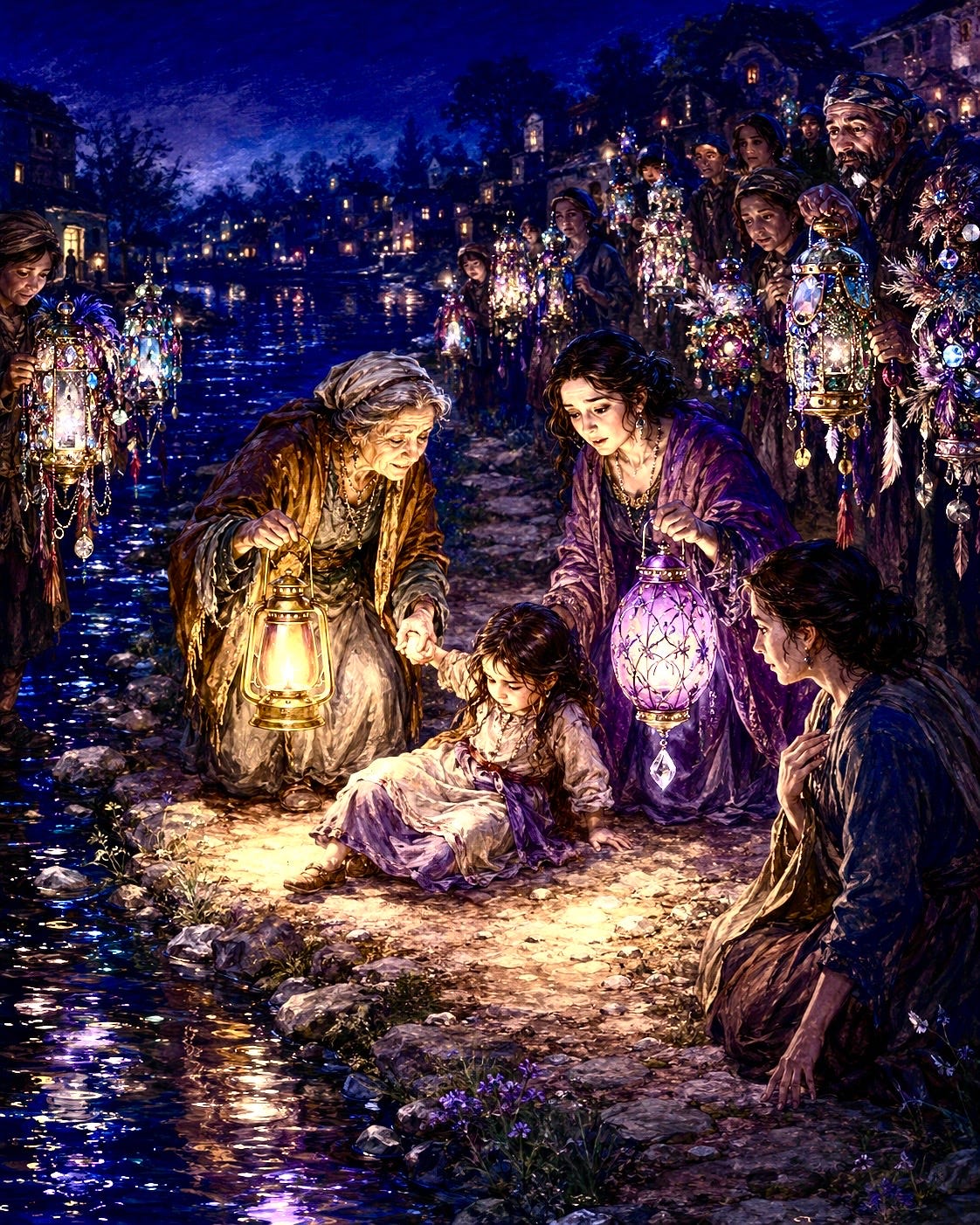
A traveling salesman came into the village just before dusk, when the sky was turning the color of bruised plums and the road dust had begun to cool.
His cart rattled behind a tired gray mule. From its wooden sides hung rows and rows of lanterns.
At first glance, they were nothing special.
Simple black lanterns. Plain glass. Plain handles. No paint, no carvings, no ornament. One looked much like the next. A lantern for walking. A lantern for seeing. A lantern for finding your way home.
But each one, the salesman promised, carried a flame that would never go out.
The villagers gathered around him in the square.
“A lantern that never dies?” asked the baker.
“A lantern that does not need oil?” asked the miller.
“A lantern that can be carried through rain?” asked a girl with a missing tooth.
The salesman smiled the smile of a man who knew how to sell wonder without explaining it.
“It will burn as long as you carry it,” he said. “And as long as you remember what it is for.”
No one paid much attention to the second part.
By morning, nearly every household in the village had bought a lantern.
At first, they changed everything.
Before the lanterns came, night belonged to locked doors, shuttered windows, and the small circle of candlelight inside each home. People went out only when they had to. The path to the river was dangerous after dark. Roots curled across it. Stones hid in the grass. Once, old Mara had fallen and broken her wrist walking home from her sister’s house.
But now the village opened after sunset.
Children chased moths along the lanes. Lovers walked beside the orchards. Neighbors who had barely spoken in years began meeting at the well after supper. The old men carried their lanterns to the bridge and argued about weather, taxes, and whether the dead could hear church bells.
The young people wandered down to the river, where they set their lanterns in a circle and watched the water catch the glow.
It was beautiful.
The river shone like a road the stars had forgotten to take home. Faces that had once disappeared into shadow were visible again. People saw one another’s eyes when they spoke. They saw when someone had been crying. They saw when someone was tired and needed help carrying a basket. They saw the narrow places in the path and held their lights lower so others would not trip.
For a while, this was enough.
Then one evening, a woman named Elia came to the river carrying a purple lantern.
It was the same lantern as everyone else’s. Same glass, same handle, same steady flame. She had simply painted the frame because purple was her favorite color and she was tired of mistaking hers for her cousin’s.
Everyone admired it.
“That is lovely,” said the baker’s wife.
“Clever,” said the miller.
“Mine would look nice in green,” said a boy.
The next week, there were five painted lanterns at the river.
The week after that, there were twelve.
No one minded. It made the gatherings cheerful. People laughed when old Mara painted hers bright yellow and said she had spent enough of her life being tasteful. The children painted flowers on theirs. The blacksmith’s daughter covered hers in little blue waves. A widower painted his with the exact red of his wife’s favorite scarf.
For a while, the paintings seemed to make the lights more personal. People could recognize one another coming down the lane from far away.
Then someone tied a ribbon to a lantern handle.
Then someone added beads.
Then someone brought a lantern with a crystal hanging beneath it, so the flame scattered tiny shards of color across the ground.
That caused a stir.
By the next gathering, crystals were everywhere. The riverbank glittered. Children ran their hands through the little patches of colored light. The young men laughed and pretended not to care whose lantern cast the widest pattern.
A month later, the first gold chain appeared.
It hung from a polished lantern carried by a merchant’s wife, who claimed her sister in the city had sent it. The chain served no purpose, but it caught the light beautifully. When she set her lantern by the river, people turned to look.
After that, the village changed more quickly.
Lanterns came with feathers tied to the handles, bells on the corners, tiny mirrors glued to the frames, charms, tassels, carved wooden birds, painted moons, silver thread, and little hats made from scraps of velvet. One boy attached a fan to his lantern that spun when he walked. The schoolteacher wrapped hers in lace. The butcher’s son added so many brass coins that his lantern chimed like a purse with every step.
At first, the decorations were only decoration.
Then they became introductions.
Then they became declarations.
People no longer arrived at the river simply carrying lanterns. They arrived presenting them. They slowed at the path so others could see. They tilted them toward compliments. They stood beside them with the shy pride of someone who had turned a useful thing into a version of themselves.
The village began holding contests, though no one called them contests.
They said, “Let us admire the lanterns.”
They said, “Let us celebrate creativity.”
They said, “Let us honor what each person has made.”
And truly, some of the lanterns were astonishing.
One had a frame shaped like a swan. One had panes of blue glass painted with constellations. One was surrounded by copper leaves that trembled in the wind. One had mirrors arranged so carefully that it seemed to burn brighter than the others, though no one could quite tell where its own light began.
The salesman had long since moved on to another town, but his lanterns remained.
By winter, people had stopped walking much at night.
The lanterns were too heavy now.
A simple trip to the river required preparation. Feathers had to be brushed. Chains untangled. Crystals polished. Mirrors cleaned of fingerprints. The butcher’s son needed both hands to carry his, and sometimes his younger brother had to walk beside him holding up one side.
The children no longer ran ahead with their lights. Their parents told them not to jostle the decorations.
Neighbors no longer lifted their lanterns low to show stones in the path. The decorations were too fragile, and besides, people were looking at the lanterns now, not the road.
Still, the river gatherings continued.
They had become the pride of the village.
Travelers came to see them. Songs were written about them. The merchant’s wife claimed no town in the valley had lanterns like theirs. People began arriving before dark to claim the best spots on the bank.
One night, after the first hard frost, old Mara came down to the river with her yellow lantern stripped nearly bare.
The paint remained, chipped in places. Everything else was gone.
No ribbons. No beads. No brass moons. No little polished stones around the glass. Just the lantern, its handle, its yellow frame, and the flame inside.
A few people stared.
“Did something happen to it?” asked the baker’s wife.
“It got too heavy,” Mara said.
The butcher’s son laughed, not cruelly, but loudly enough that others joined him.
Mara shrugged and set her lantern near the water.
Not far from her stood Elia.
Her purple lantern was still beautiful. Vines curled along its frame in careful strokes. The paint had worn thin where her hand held the handle. One small crystal hung beneath it, low enough to catch the flame without crossing the glass.
It did not look plain.
But it gave light.
No one spoke much about either lantern.
Then the clouds moved in.
There was no moon that night, and no stars. The riverbank should have glowed anyway, as it always had. The villagers set down their lanterns in rows and clusters, polished and painted and jeweled, each more elaborate than the next.
But something was wrong.
The light did not spread.
It flashed here and there, caught in mirrors, broken by crystals, trapped behind lace and paint and velvet. It glittered, yes. It sparkled. It drew the eye in a hundred directions. But it did not show the path. It did not reach the faces. It did not touch the water except in small, trembling fragments.
The river stayed dark.
For a while, no one said anything.
Then a child tripped over a stone and began to cry.
Her mother lifted a lantern to help her, but three strands of beads swung across the glass and the light fell in stripes. The child’s knee bled in the shadow.
Old Mara picked up her yellow lantern and carried it over.
Elia came too, lifting her purple one.
Between them, the ground filled with clean amber light.
The mother saw the scrape. The child saw her mother’s face. The others saw, too, though some pretended to be examining their own lanterns.
After that, people began to notice things.
The path home had become difficult to see.
The bridge steps were darker than they used to be.
Faces looked strange beneath scattered reflections.
The most admired lanterns shone brilliantly from a distance, but up close they gave little help to anyone trying not to stumble.
That night, the villagers walked home slowly.
Some removed decorations before they reached their doors. A ribbon here. A charm there. The butcher’s son cut loose half the brass coins from his lantern before climbing the hill. The schoolteacher peeled lace from the glass and wept a little, though she could not have said why.
By morning, the village was divided.
Some said they had forgotten what the lanterns were for.
Some said beauty had gone too far.
Some said the lanterns should be returned to their first simplicity, or at least cleared enough that the flame could do what flame was meant to do.
Others were offended.
They said the plain lanterns were dull. They said the decorated lanterns made people happy. They said no one had the right to tell anyone else how to carry light.
Elia said nothing.
She only turned her lantern in her hands, studying the places where beauty served the flame and the places where it nearly covered it.
And some, who had no intention of removing a single feather or jewel or chain, added mirrors.
The mirrors were clever. Very clever. They caught the cleaner glow of the lanterns that still gave light and threw it back in flashes. From across the riverbank, the mirrored lanterns looked brilliant again.
For a while, that seemed to settle the matter.
The decorated lanterns glittered. The cleared ones shone. Everyone gathered in the same place, and the river held what light it could.
Then one evening, a few of the villagers with clearer lanterns walked farther down the bank to help a child find a lost shoe in the reeds.
As they moved away, the brightness around the mirrored lanterns faded.
Not all at once. Not dramatically. Just enough.
A face disappeared into shadow. A hand reached for a cup and missed. Someone stepped back from the water and stumbled over a root.
The villagers with the mirrored lanterns looked down.
Their lanterns were still beautiful. The feathers still trembled. The crystals still scattered color. The gold still caught whatever light reached it.
But beneath all that, their own flames had been covered so long they barely touched the glass.
No one had taken the light from them.
No one had shut them out.
They had simply been standing close enough to the cleared lanterns to forget the difference.
After that, some went home quietly and began removing what they could. Not everything. Not all beauty. Just enough for the flame to breathe again.
Others polished their mirrors brighter.
Years later, children would ask why Elia’s purple lantern hung above the door of the meeting hall.
It was not plain. Vines still curved along its frame. The purple paint had chipped in a few places, and one small crystal still hung beneath the handle, where it caught the flame without crossing the glass.
It was beautiful.
But it was also bright enough to show the step beneath the door.
The adults would tell them it was because once, for a little while, the village had mistaken admiration for illumination.
Old Mara had helped them remember the flame.
Elia had helped them remember that beauty was never the enemy.
Only whatever kept the light from doing what light had come to do.
And some of them learned.
And some of them sat in borrowed light, wondering why the dark always followed them home.
🌹